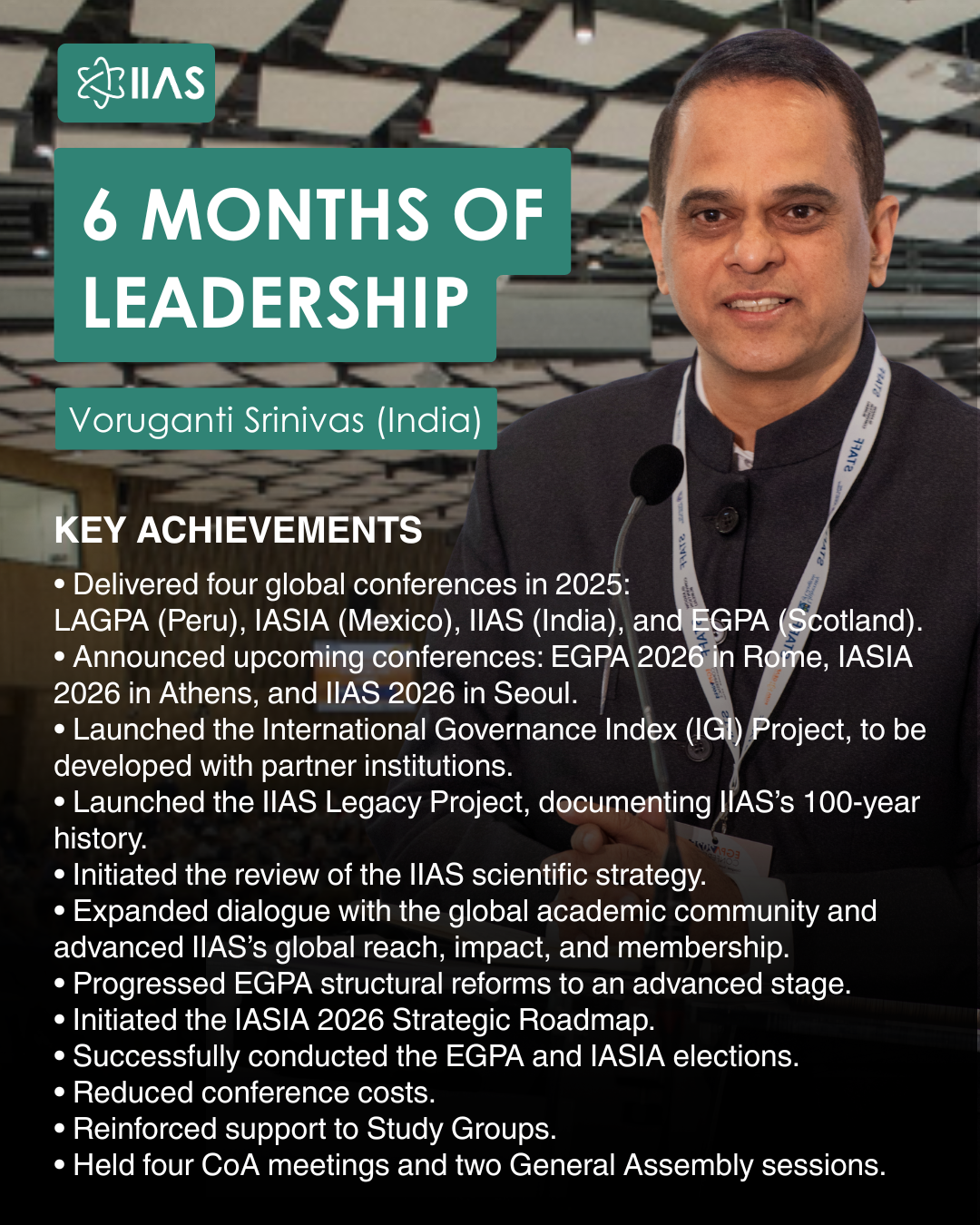
Six months into his historic tenure as the first Global South President of the International Institute of Administrative Sciences (IIAS), Voruganti Srinivas reflects on the Institute’s remarkable achievements and the path ahead. Elected with broad support from the membership, President Srinivas has steered the IIAS toward a vision of “collaboration without borders, knowledge without boundaries, and governance without exclusion,” emphasizing a digitally agile, publications-rich, and resource-strong institution.
In this exclusive interview, he shares insights on the progress made across international conferences, institutional reforms, global engagement, and emerging priorities. President Srinivas also discusses initiatives like the International Governance Index and IIAS Legacy Project, the Institute’s growing inclusivity, and his ongoing efforts to strengthen trust, unity, and the global reach of public administration.
Six months ago, when you assumed the IIAS Presidency, you outlined a vision grounded in “collaboration without borders, knowledge without boundaries, and governance without exclusion,” and in shaping a “digitally agile, publications-rich, and resource-strong” institution. Looking back, how do you assess the progress made toward this vision?
The Indian Presidency of the International Institute of Administrative Sciences was a historic moment for both India and the IIAS, as it represented the first Global South Presidency of the IIAS in 96 years. Elected with a significant mandate and support from the membership, India has taken forward the Presidency’s vision of “collaboration without borders, knowledge without boundaries, and governance without exclusion.” Further, we have made considerable progress in completing the elections to the IIAS entities – IASIA and EGPA, the orderly resolution of the EGPA developments, and the successful conduct of four international conferences. The Indian Presidency’s achievements are significant and represent the foundations for the entire term.
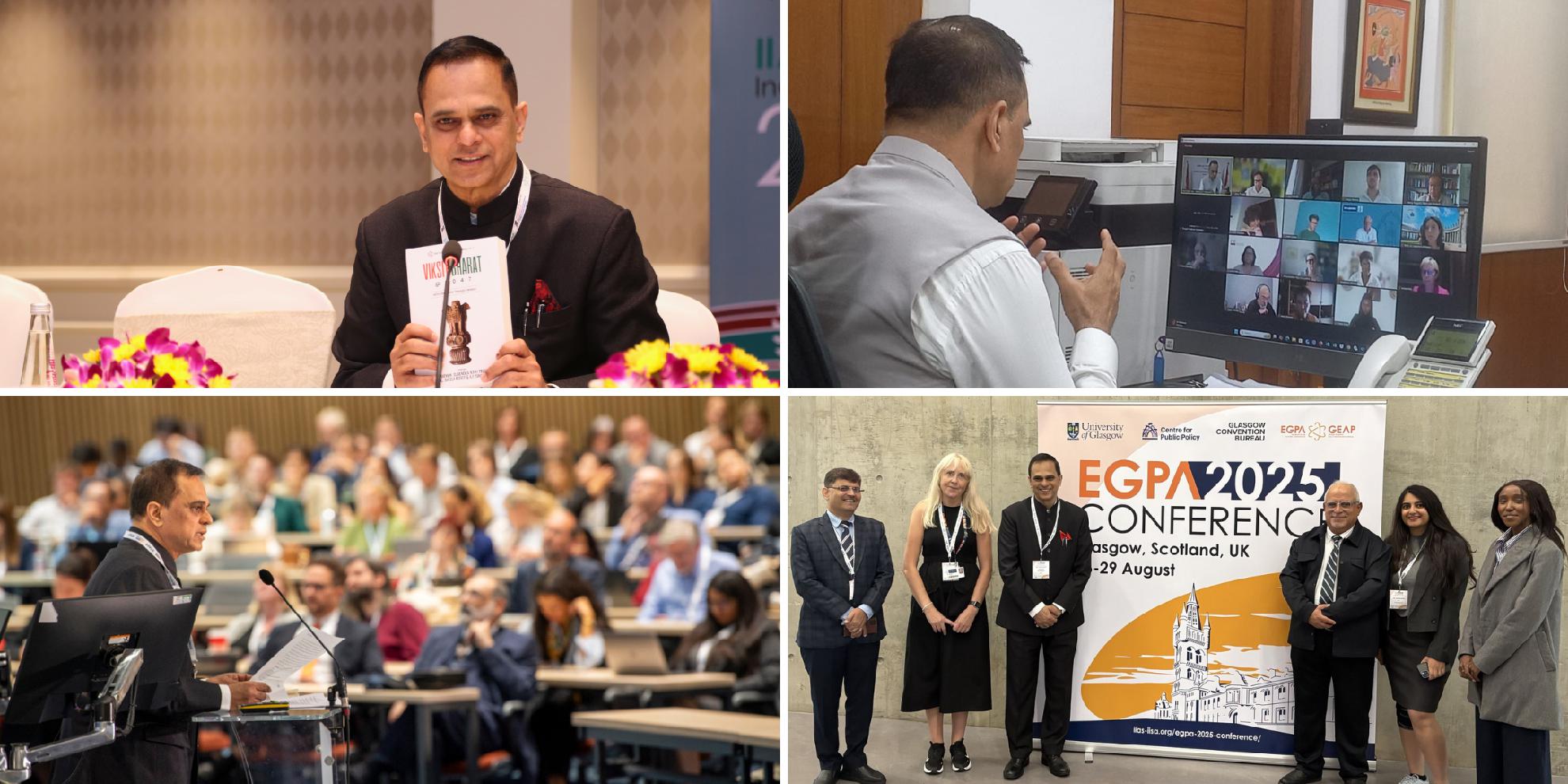
In 2025, IIAS delivered four major global conferences across three continents: IIAS Conference in New Delhi (India), EGPA Conference in Glasgow (Scotland), IASIA Conference in Mexico City (Mexico), and LAGPA Conference in Lima (Peru), and has already announced the events for 2026. How have these achievements strengthened IIAS’s global positioning, visibility, and engagement?
The IIAS is uniquely positioned as the only global institution that could conduct four multi-continental conferences in one year. The IIAS–DARPG conference in New Delhi represented the largest and most successful conference in the history of IIAS, with 758 delegates from 58 countries. The EGPA Conference in Glasgow was the largest in EGPA history, with 1,000 delegates. The IASIA Conference in Mexico City and the LAGPA Conference in Lima were both well-attended events. I am also happy to announce that the 2026 conference venues have been identified and progress is on track.
The review of the scientific strategy, the reinforced support to Study Groups, and the advanced progress of EGPA reforms were among the major institutional milestones this year. What impacts are you already observing from these reforms, both internally and across the IIAS community?
The Scientific Strategy of the IIAS is handled by the Research Advisory Committee. The Indian Presidency has collaborated with the PRAC to strengthen the scientific strategy by developing effective global metrics to advance comparative public administration models. The Indian Presidency has also recommended the continued strengthening of publications through the International Review of Administrative Sciences (IRAS). Further, the EGPA reforms oriented toward promoting Public Administration in Europe have been well received – the EGPA Steering Committee under President Sabine Kuhlmann has decided to lower conference costs and provide enhanced support to Permanent Study Group chairs. The Indian Presidency reiterates its deep commitment to extend all support to EGPA’s efforts for bolstering European Public Administration.
In your view, what concrete steps should IIAS take to more effectively support the Study Groups and Working Groups, in terms of visibility, engagement, finances, and scientific impact?
The Permanent Study Groups are unique to EGPA, and all support will be extended. The Finance Committee under Prof. Jorg Bogumil is finalizing the financing arrangements for the PSG study groups.
This year also saw the proposal of key initiatives such as the International Governance Index (IGI) and the IIAS Legacy Project. Why are these initiatives important for the Institute’s mission, and what value do they bring to governments and public administration worldwide?
The Indian Presidency is collaborating with the PRAC to develop an International Governance Index as a true measure of public policy and governance. The initiative is promising and will benefit the global community. Exploring new horizons is always exciting.
You emphasized the importance of expanding participation from underrepresented regions and deepening South–South cooperation. What progress has been made in these first six months, and how do you assess IIAS’s growing global reach and diversity?
The Indian Presidency is the first Global South Presidency of the IIAS. This was made possible because of the support we received across the membership. The quest for inclusiveness, and openness to explore new horizons for the IIAS by popularizing the Institute in East Asia, South Asia, Latin America, and Africa, provides exciting new opportunities for future institution building.
Themes such as digital transformation, AI governance, climate action, democratic resilience, the future of governance, and next-generation administrative reforms have gained prominence in governance discussions worldwide and have been central to recent IIAS conferences. What role should IIAS play in shaping global conversations on these emerging issues?
21st-century public administration requires the use of advanced mathematical models to address public policy challenges. There exists a direct correlation between citizens’ trust in governance and the quality of governance provided. The use of AI enables disaggregated data analytics for better understanding of root causes and identification of solutions.
You began your presidency at a moment that required rebuilding trust and strengthening institutional unity. After four CoA meetings, two General Assembly sessions, and numerous strategic dialogues with leaders, academics, and chairs, how would you describe the current institutional climate within IIAS?
I have enjoyed broad support from the IIAS membership on each of the Indian Presidency’s initiatives for rebuilding the IIAS. The EGPA developments required considerable negotiation skills and interpersonal relations for orderly resolution. Today, a resurgent EGPA will move forward to serve European Public Administration. The IASIA elections were a landmark, and President IASIA Prof. Lezel Luis has detailed her vision of further expanding this significant organization.
With the IASIA 2026 Strategic Roadmap underway, the EGPA reforms advancing, and preparations beginning for the 2026 conferences, what will be your main strategic priorities for the coming year?
The focus will be on continuity and delivery. In 2026, I seek to consolidate the scientific strategy, advance the International Governance Index, finalize reforms, and grow membership to emphasize the global impact and presence of IIAS.
After six months leading the Institute, what message would you share with our global PA community to encourage them to keep driving research, innovation, and governance reforms that meaningfully enhance the everyday lives of people and strengthen public institutions worldwide?
The IIAS has significant outreach, and the next year promises to be very exciting. 2025 marked historic changes in administrative leadership within IIAS, EGPA, and IASIA. 2026 will be a year of consolidation.